
 Individual

- Home>
- Blog>
- Tax-Savings>
- ITR 2




Invest ₹20K/Month & get ₹4.24Cr^1a Now!

Income Tax Department of India ...Read More
Trust of 20+ Years in Industry


Written byAbhishek Chakravarti

Reviewed byAlok Mishra
Last Modified 16th July 2026
Taxation & Finance Expert

Axis Max Life Savings Plans


What is ITR2?
ITR 2 means Income Tax Return Form 2. This income tax return form is only available for individuals and Hindu Undivided Families (HUFs) who do not have any income under the head “profits and gains from business or profession”, but are not eligible to file returns using ITR 1 Form (Sahaj).
So some examples of taxpayers who are required to file ITR 2 form for AY 2023-24 include:
Salaried taxpayers who hold the post of director with a listed or unlisted company
Individuals/HUF who have income under the head “capital gains”
Individuals/HUFs who have earned annual income in excess of Rs. 50 lakh for FY 2022-23
It must additional be pointed out that ITR Form 2 cannot be filed by individual or HUF taxpayers in AY 2023-24 if they have earned any income under the head “profits and gains from business or profession” during FY 2022-23.
What is the Structure of ITR 2 Form?
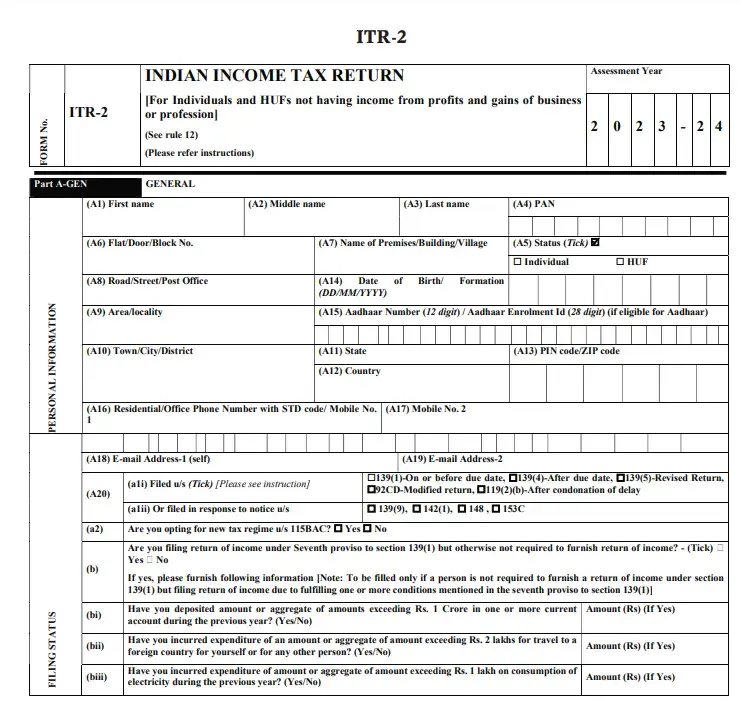
ITR 2 form is divided into different sections as below:
1) Part A of ITR 2: General Information containing personal data
2) Filing Status: Reason for filing such as filing before due date (Section 139(1)), delayed filing Section 139 (4), filing in response to IT department notice, revised return filing, etc.
3) ITR 2 Form Schedule S: Details of your income received as salary
4) ITR 2 Form Schedule HP: Details of your income received from one or more house property (taxpayer also needs indicate ownership of the property)
5) ITR 2 Form Schedule CG: Detailed computation of your income from capital gains (from sale/transfer of various types of capital assets, including long-term and short-term capital gains)
6) ITR 2 Form Schedule 112A & Schedule 115AD(1)(b)(iii)-Proviso: Income from sale of equity shares in a company or unit of equity oriented fund or unit of business trust on which STT is paid u/s 112A or Schedule 115AD(1)(b)(iii)-proviso, as per applicability
7) ITR 2 Form Schedule VDS: In this section the filer needs to provide details of capital gains obtained from sale of any virtual digital assets like cryptocurrency, non-fungible tokens (NFTs) made in FY 2022-23
8) ITR 2 Form Schedule OS: Details of computation of your earnings under the head “income from other resources” such as rental income from machinery, buildings, and lottery
9) ITR 2 Form Schedule CYLA: Statement of your income after setting off current year’s losses
10) ITR 2 Form Schedule BFLA: Details of income after setting off brought forward losses of previous years
11) ITR 2 Form Schedule CFL: Details of losses that are being carried forward to following years
12) ITR 2 Form Schedule VIA: All deductions under chapter VI-A this section further contains 2 tables. Table 1 Part B contains details of deductions including Section 80C, 80CCC, 80CCD, 80D, 80E, 80G, 80GG, etc. Whereas Table 2 Part C, CA and D contains details of other deductions like 80QQB, 80TTA and 80TTB, 80U, etc.
13) ITR 2 Form Schedule 80G: All details of donations made in a year entitled under section 80G
14) ITR 2 Form Schedule 80GGA: All details of donations for rural development or scientific research only
15) ITR 2 Form Schedule 80D: Deductions with respect to health insurance premium u/s 80D for self, dependent family members and parents including senior citizen parents are to be provided here.
15) ITR 2 Form Schedule AMT: Detailed computation of alternate minimum tax payable under section 115JC
16) ITR 2 Form Schedule AMTC: Detailed calculation of tax credit under section 115JD
17) ITR 2 Form Schedule SPI: Income of specified people (minor child, spouse, or similar) included in the total income of the assessee under section 64
18) ITR 2 Form Schedule SI: Income which is liable to be taxed at special rates
19) ITR 2 Form Schedule EI: All details of income that is exempt from tax
20) ITR 2 Form Schedule PTI: Pass through Income details from business trust or investment fund u/s 115UA and 115UB
21) ITR 2 Form Schedule FSI: Statement of income accruing or arising outside India
22) ITR 2 Form Schedule TR: Entire summary of tax relief claimed under tax paid in countries other than India
23) ITR 2 Form Schedule FA: All details of foreign assets and income from any sources obtained from a country other than India
24) ITR 2 Form Schedule 5A: Information regarding income apportionment between spouses being under the Portuguese Civil Code
25) ITR 2 Form Schedule AL: Details of movable/immovable asset and liability at the end of FY 2022-23 for taxpayers with income exceeding Rs. 50 lakh during the year. This section should include details of assets like residential/commercial property, jewellery, bullion, bank deposits, insurance policies, loans and advances, etc.
26) ITR 2 Form Schedule Tax Deferred on ESOP: Information regarding deferment of tax payable on Employee Stock Options/sweat shares received from an eligible employer
27) Part B-TI: Computation of Total Income from various income sources
28) Part B-TTI: Computation of tax liability on Total Income
29) TRP Details: This section will include relevant details of a Tax Return Preparer (TRP), if the filing is done with assistance of a TRP.
30) Item No 20 – Tax payments
IT 2 Form – Item no 20 - Part A – All details of payments made under advanced tax or self-assessment tax
IT 2 Form – Item no 20 - Part B – TDS on salary details
IT 2 Form – Item no 20 - Part C – TDS (tax deducted at source) details on income other than salary
IT 2 Form – Item no 20 - Part D – TCS (tax collected at source) details during FY 2022-23 as mentioned in form 27D
31) ITR 2 Form- Verification – Enter details for verification as per given specifications (return of income verified by individual taxpayer or by Karta of HUF)
Who is Eligible to File ITR 2 Form?
ITR 2 or Income Tax Return Form 2 can be used by individuals and HUFs who are not eligible to file using ITR Form 1 due to any reason. However, such Individuals and HUFs can file ITR 2 only if they have not received any income under the head “Profits and gains from business or profession” during FY 2022-23.
So, if you have income from the following sources, you must file ITR-2:
1) Salary/pension income
2) Income from one or more house property
3) Income from short-term/long-term capital gains or losses from the sale of property or investment
4) Income from other sources except salary like lottery, different legal meaning of gambling, bets on horse races
5) Agricultural income of more than Rs. 5000
6) Having foreign income or holding overseas assets
7) Income from capital gains from sale of virtual digital assets like non-fungible tokens (NFTs), cryptocurrencies like bitcoin, etc.
Other criteria for filing ITR 2 in AY 2023-24 include the following:
1) Non-resident or a resident not ordinarily resident taxpayer
2) Directorship of listed or unlisted company
3) Holding investments in unlisted shares of one or more companies
Understanding the Different Income Sources Reported in ITR 2
ITR-2 is specifically meant for certain individual and Hindu Undivided Family (HUF) taxpayers who do not have any income from business or profession but might have income from multiple sources. Understanding the income that needs to be reported in ITR 2 can assist taxpayers in choosing the correct ITR form, filing their tax returns correctly, and minimising any errors in filing.
Income from Salary and Pension
Salary or pension-receiving individuals can file ITR-2 if they are not eligible to use ITR-1 because of other income sources like capital gains, foreign assets, or multiple house properties. Salary details generally include basic pay, allowances, perquisites, pension income, and tax deducted at source (TDS) reflected in Form 16.
Income from House Property
ITR-2 can be used to record revenue from one or more rental properties. This includes rental income from the properties which are rented and also presumed rental income from properties which are not self-occupied. Taxpayers can also claim qualified deductions such as municipal taxes and interest paid on a home loan, subject to appropriate restrictions under the Income Tax Act, 1961.
Capital Gains from Investments and Property
ITR 2 is also applicable to taxpayers who have received short-term or long-term capital gains from the transfer of equity shares, mutual funds, land, buildings or other capital assets. The form includes specific schedules that can be used to record capital gains, capital losses, and claiming eligible exemptions under the relevant provisions of the Income Tax Act.
Foreign Income and Overseas Assets
Individuals who hold foreign assets or earn income from sources outside India are required to disclose such information while filing ITR-2. These could include foreign bank accounts, investments abroad, foreign shares, or income earned outside India. It is essential to report correctly, as failure to declare foreign assets may trigger disciplinary actions under the applicable legislation.
Who is Not eligible for filing ITR 2?
Taxpayers are not eligible to file ITR 2 if they meet one or more of the below criteria:
1) Individual or HUF having income under the head “profits and gains from business or profession” during FY 2022-23
2) Individuals and HUF eligible for filing ITR Form 1 (Sahaj) for AY 2023-24.
Documents You Should Keep Ready Before Filing ITR-2
Organised paperwork can speed up the process of submitting income tax returns. It also prevents errors that could result in delays or notices from the income tax authorities.
Essential Identity and Tax Documents
The following documents are generally required before starting the filing process:
- PAN Card
- Aadhaar Card
- Details of the previous year's income tax return, if applicable.
Income-Related Documents
Keep all income-related documents handy, including:
- Form 16 from your employer.
- Interest certifi
- ates from banks or financial institutions.
- Records of rental revenue and municipal taxes that have been paid for let-out property.
Investment and Capital Gains Statements
Taxpayers reporting capital gains should keep the following documents ready:
- Statements of mutual fund accounts.
- Share transaction statements and broker reports.
- Documents for real estate purchase and sale.
Tax Verification Documents
Before filing ITR-2, taxpayers should also review the following tax records:
- Form 26AS
- Annual Information Statement (AIS)
- Taxpayer Information Summary (TIS)
How to File ITR 2?
You can file ITR Form 2 online as well as offline. For ITR 2 download , you can visit official website of the income tax department.
How to File ITR 2 Offline?
1) Only individuals above 80 years or more can file ITR 2
2) ITR 2 can be filed by furnishing a return on a physical paper form at your nearest IT office
3) ITR 2 can be filed by furnishing a bar-coded return at your nearest IT office
The income tax department will issue an acknowledgement slip after completion of the submission process.
How to File ITR 2 Online?
ITR 2 download can be carried in case of individuals and HUFs not having income profits and gains of business or profession. Proceed with ITR 2 download and follow these steps:
1) Furnish the return online / electronically with your digital signature
2) Transmit your data electronically
3) Submit verification for ITR-V

After the completion of ITR Form 2 download and its electronic submission, the acknowledgement will be sent to your registered email address. It is also available for download on the official website of income tax.
Sign the acknowledgement of ITR 2 and send it to the office of CPC in Bangalore within 120 days of filing ITR 2 form online. Do not attach any documents.
Preparing for a Smooth ITR-2 Filing Experience
Preparing documents and checking your tax records before filing might make the return submission process easier. It also helps taxpayers accurately declare their income, prevent omissions and finish the filing process with more confidence.
Verify Pre-Filled Information Before Submission
The Income Tax Department offers a pre-filled form. This form features various pre-fetched such as personal information, salary details, other earning records, etc. available from multiple sources such as Form 16, Form 26AS, etc. Taxpayers should evaluate this information carefully and implement the appropriate adjustments.
Match Income Details Across Tax Records
Income reported in Form 16, Form 26AS, AIS, and bank statements should match the information disclosed in the return. Any mismatch may lead to notices or delays in processing the return.
Review Capital Gains and Other Disclosures
If you are a taxpayer who reports capital gains, overseas assets or numerous residential properties, you must carefully check the data provided in the relevant schedules of the return. Wrong reporting can lead to miscalculation or even more inquiries from tax authorities.
Complete Verification Before Final Submission
Taxpayers should thoroughly check ITR-2 before completing the return to ensure that there are no mistakes or omissions in the information given. Once details are validated, the return could be verified by Aadhaar OTP, net banking or any other authorised mode of verification. Keep in mind that the income tax return is said to be filed successfully only once the verification process is completed. The return must be verified within the specified time period or the filing may be invalid.
Significant Changes Introduced in ITR 2 for AY 2023-24
Below is a list of the key changes that have been made to the Income Tax Return form 2 for AY 2023-24:
1. New field has been inserted – “Whether you are FII/FPI?”. Those answering yes that they are a foreign institutional investor (FII) or foreign private investor (FPI) will need to provide relevant SEBI (Securities Exchange Board of India) registration number
2. In salary schedule of ITR 2, new field for relief under Section 87A has been added.
3. ITR 2 for FY 2022-23 also features 3 new fields in the Schedule CG this year:
a) Short term capital gains amount deemed to be long-term capital gains
b) Income from transfer of virtual digital assets
c) Income chargeable under the head “Capital Gain” (Sum of above inputs)
4. Schedule TCS (tax collected at sources) has been revamped to include claiming of brought forward TCS and for carrying forward TCS
5. Schedule VDA has been added to include details of income from transfer of virtual digital assets
6. Schedule VI A of ITR 2 for AY 2023-24 now allows input of details of deduction under Section 80CCH
7. A new field has been inserted in Schedule 80G where the tax payer can provide donation reference number
8. Schedule Part B TI for ITR 2 features a new field “Capital Gains chargeable @30% u/s 115BBH”. This refers to the capital gains tax payable on transfer of virtual digital assets during FY 2022-23.
Special Instructions to File ITR 2 Form
1. For schedule not applicable to you – strike or mention NA
2. Indicate nil figures with ‘Nil’
3. Place hyphen (–) before negative figures
4. Round off all figures to nearest one rupee except for losses, total income, or tax payable
5. For individuals under ‘Employer’ category, mark ‘Government’ for central / state government employee; else mark ‘PSU’ for public sector company

Conclusion
The Income Tax Return Form-2 (ITR-2) can only be used by individuals who are not eligible to file returns using ITR-1 and Hindu Undivided Families (HUFs) who do not have any income under the head “profits and gains from business or profession”. This form allows the tax payer to choose between filing returns under the new tax regime or the old tax regime. While the new tax regime features lower income tax slab rates, it does not allow tax payers to benefit from tax deductions applicable under Sections such as 80C, 80D, etc.
However, this means that the tax benefits applicable on paying premiums for a term life insurance policy such as Axis Max Life Smart Secure Plus Plan cannot be claimed if one is filing ITR-2 using the new tax regime. Yet, a term plan is essential for providing a financial safety net for your loved ones, in the case of your untimely demise. What’s more, opting for optional riders such as critical illness and disability rider can provide enhanced protection that might help manage your finances better, if you have to undergo expensive treatment after being diagnosed with any listed critical illness.
FAQs About ITR 2

Q. Can I file ITR 2 when I have sold my housing property?
A. Yes. You can file ITR 2 when you have sold your housing property.
Q. What qualifies as an exempt income for filing ITR 2?
A. Exemptions include from section 10 – HRA, LTA, Transport allowance, gratuity, pension, leave encashment.
Q. What is the Process for ITR 2 Form Download?
A. Yes. If only your agricultural income exceeds Rs.5000, you can
A. To download ITR Form 2, you will be required to follow the steps mentioned below:
1. Visit the official website of Income Tax Department
2. Go to ‘Forms/Downloads’
3. Click on ‘Income Tax Return’
4. Proceed with ITR 2 form download
file ITR 2.Q. What are Capital Assets Under ITR 2?
A. It is any kind of property held by the assessee whether or not connected with your business or profession. Any security held by FII in accordance with SEBI Act 1992.
Q. Can salaried individuals file ITR 2 if they also have capital gains income?
Yes. Salaried individuals can file ITR-2 if they have additional income from capital gains arising from the sale of shares, mutual funds, property, or other capital assets. If you have capital gains apart from salary income, then ITR-1 may not be applicable, and you will have to file ITR-2 to declare your income correctly.
Q. When does a taxpayer need to switch from ITR 1 to ITR 2?
A taxpayer generally needs to switch to ITR-2 when they have income that cannot be reported in ITR-1. This includes capital gains, foreign assets, agricultural income exceeding ₹5,000, income from more than two house properties, or income that requires additional disclosures under the Income Tax Act.
Q. Is foreign asset disclosure mandatory while filing ITR 2?
Yes. Resident taxpayers holding foreign assets or earning foreign income are generally required to disclose these details in ITR-2. This includes foreign bank accounts, overseas investments, and certain foreign financial interests. Failure to disclose foreign assets may attract penalties under the applicable laws.
Q. What documents should be reviewed before filing ITR 2?
Taxpayers should review documents such as PAN, Aadhaar, Form 16, interest certificates, investment statements, Form 26AS, AIS, TIS, and capital gains computation statements. Keeping these documents ready helps ensure that all income and tax details are correctly reported in the return.
Q. Why is AIS information important while filing income tax returns?
The Annual Information Statement (AIS) provides information on income, taxes deducted or collected, transactions in securities and such other specified financial transactions as are available with the Income Tax Department. Verifying the AIS helps taxpayers to identify omissions or mismatches and improves the accuracy of the income tax return.
Q. Can multiple house properties be reported through ITR 2?
Yes, ITR-2 allows taxpayers to report income from more than one house. The form enables individuals to disclose rental income, claim eligible deductions, and report losses arising from house property, subject to the conditions prescribed under the Income Tax Act.
Q. What are the common reasons for errors in ITR 2 filing?
Common reasons for mistakes in ITR-2 filing include inaccurate reporting of capital gains, mismatch of Form 26AS with the return, omission of foreign assets, wrong bank data, or inability to validate pre-filled information. Take a close look at all the disclosures, and you can cut down on such inaccuracies.
Q. How can taxpayers reduce the likelihood of filing corrections later?
Taxpayers can reduce the need to file an amended return by double-checking all income information, matching up tax credits and making sure that all sources of income have been recorded correctly before filing. They should also verify the supporting documents, such as Form 26AS, AIS, and TIS, to see if there are any errors or missing information. Careful examination before filing is worthwhile to prevent errors and later unnecessary corrections.
Q. What information should be checked before final return submission?
Taxpayers must verify personal and bank account information, income disclosures, tax credits, claims of deductions and overseas assets before filing ITR-2. These checks can help prevent errors, reduce the likelihood of notices, and support seamless processing of the return.
ARN: June23/Bg/27B
Source:
https://www.incometaxindia.gov.in/Pages/downloads/income-tax-return.aspx
https://www.incometaxindia.gov.in/forms/income-tax%20rules/2020/itr2_english.pdf
https://www.policybazaar.com/income-tax/itr2-form/
https://cleartax.in/s/itr2/
https://cleartax.in/s/itr2/
https://incometaxindia.gov.in/Supporting%20Files/ITR2023/Instructions_ITR2_AY_2023_24.pdf
https://economictimes.indiatimes.com/wealth/tax/who-can-file-income-tax-return-using-itr-2-form/articleshow/93156156.cms




Tax Articles
Calculators
Health Insurance Articles
Popular Searches

Online Sales Helpline
- Whatsapp: +91-7428396005Send ‘Quick Help’ from your registered mobile number
- Phone: +91-124-648-890009:30 AM to 06:30 PM
(Monday to Sunday except National Holidays) - service.helpdesk@axismaxlife.comPlease write to us incase of any escalation/feedback/queries.
Customer Service
- Whatsapp: +91-7428396005Send ‘Hi’ from your registered mobile number
- 1860-120-55779:00 AM to 6:00 PM
(Monday to Saturday) - service.helpdesk@axismaxlife.comPlease write to us incase of any escalation/feedback/queries.
NRI Helpdesk
- +91-11-71025900 , +91-11-61329950 (Available 24X7 Monday to Sunday)
- nri.helpdesk@axismaxlife.comPlease write to us incase of any escalation/feedback/queries.